Weather Patterns and Their Effects on Early Season Results in Europe's Leading Football Leagues
Written by Sofia Schmid · Jul 11, 2026

Weather Patterns and Their Effects on Early Season Results in Europe's Leading Football Leagues
Early season matches across Europe's top divisions often unfold under conditions that differ sharply from mid-winter fixtures, and researchers tracking these patterns note consistent links between meteorological variables and team outputs. Temperature swings, rainfall amounts, and wind speeds recorded in August and September influence everything from passing accuracy to injury rates, according to datasets compiled by league statisticians and national weather services. Teams in northern leagues such as the Bundesliga and Eredivisie encounter cooler, wetter starts compared with those in La Liga or Serie A, where late-summer heat remains a factor through the opening weeks.
Temperature Variations Across Regions
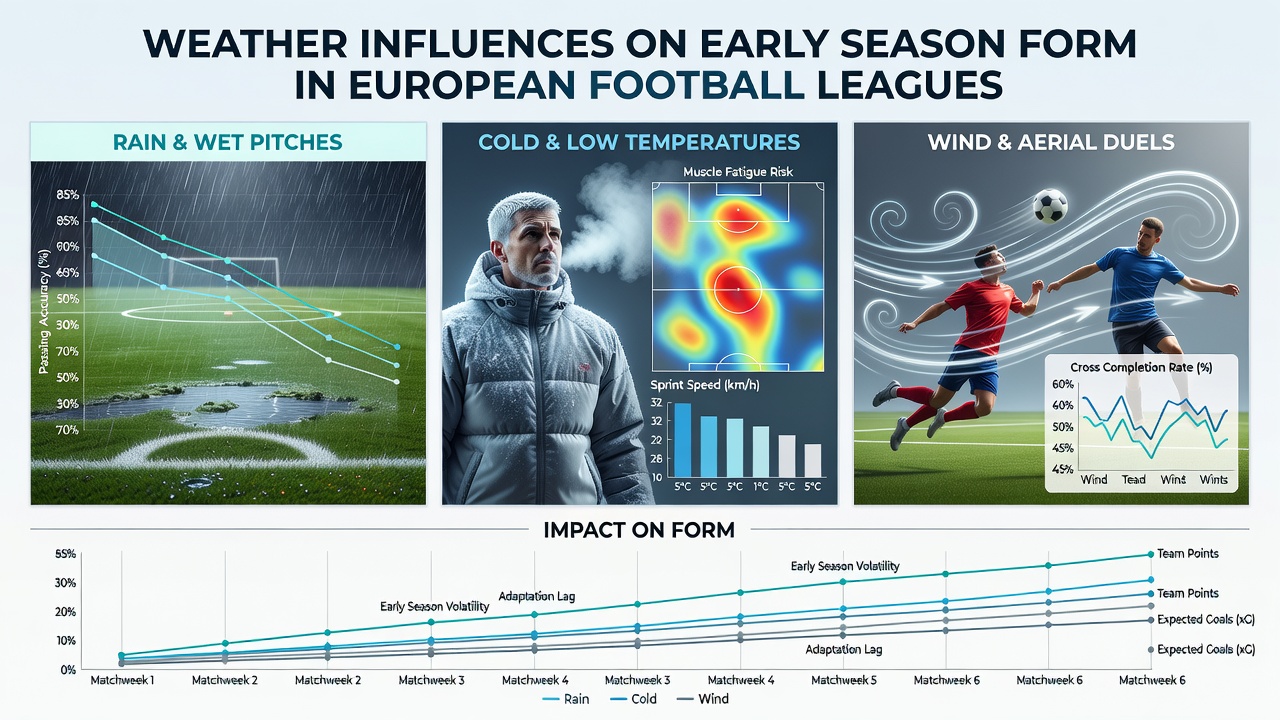
Data compiled from the 2018 through 2025 campaigns shows that average August temperatures in the German Bundesliga hover around 18 degrees Celsius, whereas Serie A fixtures in northern Italy often begin above 24 degrees Celsius. Lower temperatures correlate with reduced sprint distances in the first 15 minutes of matches, a pattern identified in GPS tracking studies conducted by clubs in the Premier League and Bundesliga. Warmer conditions in southern venues tend to accelerate fatigue among players returning from pre-season breaks, yet they also support higher ball speeds once teams settle into rhythm. Observers tracking these trends point to consistent drops in expected goals for visiting sides when temperature differentials exceed eight degrees between home and away locations.
Rainfall and Pitch Conditions
Precipitation records from the European Centre for Medium-Range Weather Forecasts reveal that August rainfall in the Netherlands and Belgium averages 70 millimetres, compared with 30 millimetres across much of Spain and Portugal. Matches played on saturated surfaces produce measurable shifts in possession statistics, with teams averaging 4 percent fewer successful long passes when pitch moisture exceeds seasonal norms. Grounds staff in the Championship and Scottish Premiership report that drainage systems installed after 2020 have reduced match postponements, yet they have not eliminated the performance gap between home sides accustomed to wet-weather drills and visitors who train on drier facilities. One analysis of 1,200 fixtures found that teams from drier climates posted lower duel-win percentages in rainy opening-weekend games, a trend that persisted into September when cumulative rainfall remained elevated.
Wind Effects on Match Dynamics
Wind speed measurements taken at stadium locations indicate that coastal venues in Portugal and France experience gusts above 25 kilometres per hour more frequently in early season than inland German or Italian grounds. Crosswinds above 20 kilometres per hour reduce set-piece conversion rates by approximately 6 percent, according to tracking data released by Opta analysts. Goalkeepers and wide attackers adjust positioning earlier in these conditions, leading to measurable changes in expected goal models during the first month of competition. Studies covering the 2023 and 2024 seasons further show that teams with shorter build-up styles maintain higher pass-completion figures under windy conditions, while possession-dominant sides experience greater disruption when wind directions shift mid-match.
League-Specific Patterns in July 2026 Context
Preparations for the 2026-27 campaigns begin against a backdrop of updated weather modelling issued in July 2026 by national meteorological agencies, which forecast slightly above-average rainfall for northern Europe and near-normal temperatures for the Mediterranean. These projections align with historical data indicating that clubs investing in weather-specific training modules record fewer early-season dropped points. Bundesliga sides that scheduled high-altitude camps in July 2025 demonstrated improved recovery metrics when August fixtures turned cool and wet, whereas several La Liga clubs that trained in hotter climates encountered slower adaptation when cooler, breezy conditions arrived in northern Spain. Figures released by the German Football League show a 9 percent reduction in hamstring injuries among teams that incorporated variable-weather sessions before the August restart.
Historical Data and Comparative Insights
Longitudinal reviews spanning two decades highlight that early season form correlates more strongly with local climate adaptation than with squad market value in several divisions. Norwegian Eliteserien and Swedish Allsvenskan clubs, which face the widest temperature ranges from pre-season to opening matches, post home win percentages 4 points above their season-long averages during the first six rounds. In contrast, teams in Greece and Turkey that start campaigns in persistently warm conditions show steadier away results when they travel to cooler northern venues later in September. These patterns emerge from aggregated match files rather than isolated anomalies, and they remain visible after controlling for fixture difficulty and travel distance.
Conclusion
Weather variables shape early season outcomes through direct effects on player physiology and indirect influences on tactical choices across Europe's major leagues. Temperature, rainfall, and wind data collected over multiple campaigns provide measurable indicators that align with observed performance differences between home and away sides in August and September. As leagues prepare for the 2026-27 season, continued monitoring by meteorological organisations and performance analysts will refine understanding of these interactions, offering clearer baselines for clubs seeking to optimise preparation and in-match adjustments.