Venue Sound Levels: Mapping How Crowd Volume Alters In-Play Odds Across Stadiums
Written by Sofia Schmid · Aug 1, 2026
Venue Sound Levels: Mapping How Crowd Volume Alters In-Play Odds Across Stadiums
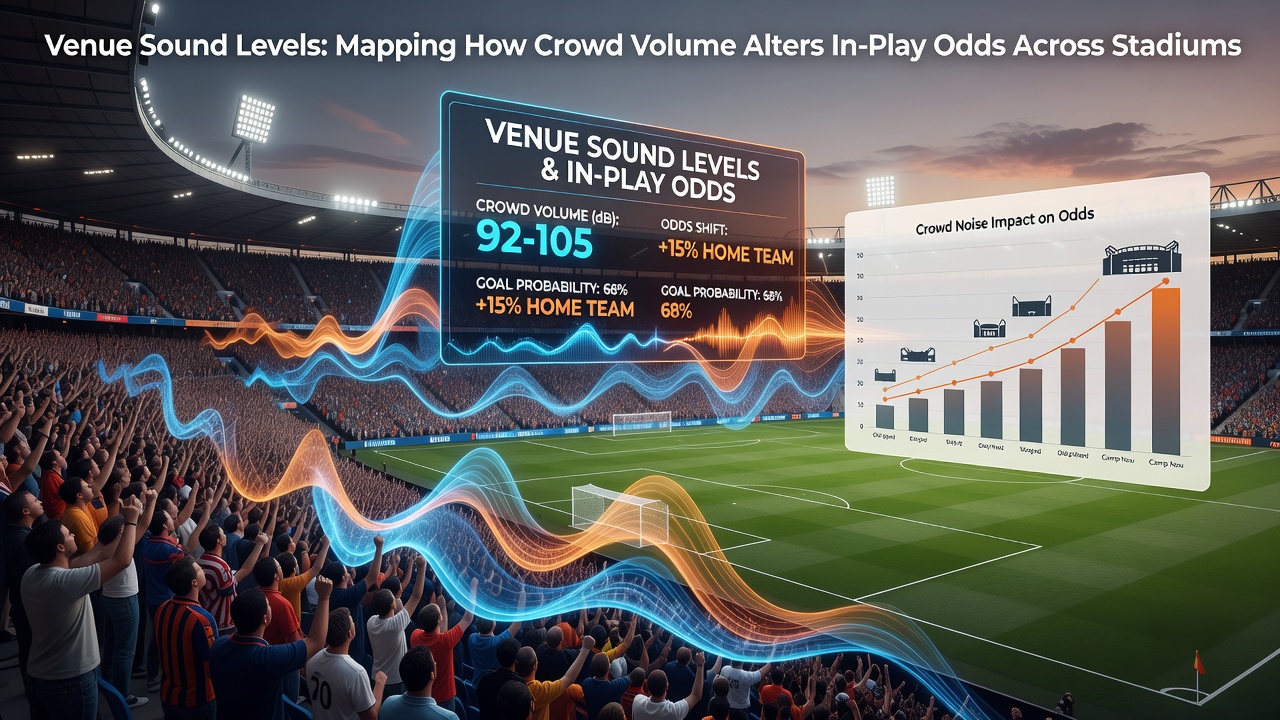
Stadium acoustics create measurable shifts in player performance and referee decisions that betting markets register through rapid adjustments in live odds. Researchers tracking decibel readings alongside betting data have documented consistent patterns where elevated crowd volumes coincide with changes in goal probabilities, point spreads, and total points lines across multiple leagues. Data collected during the 2025-2026 seasons shows these effects intensify in enclosed or steeply raked venues where sound reflects back onto the field.
Decibel Thresholds and Market Reactions
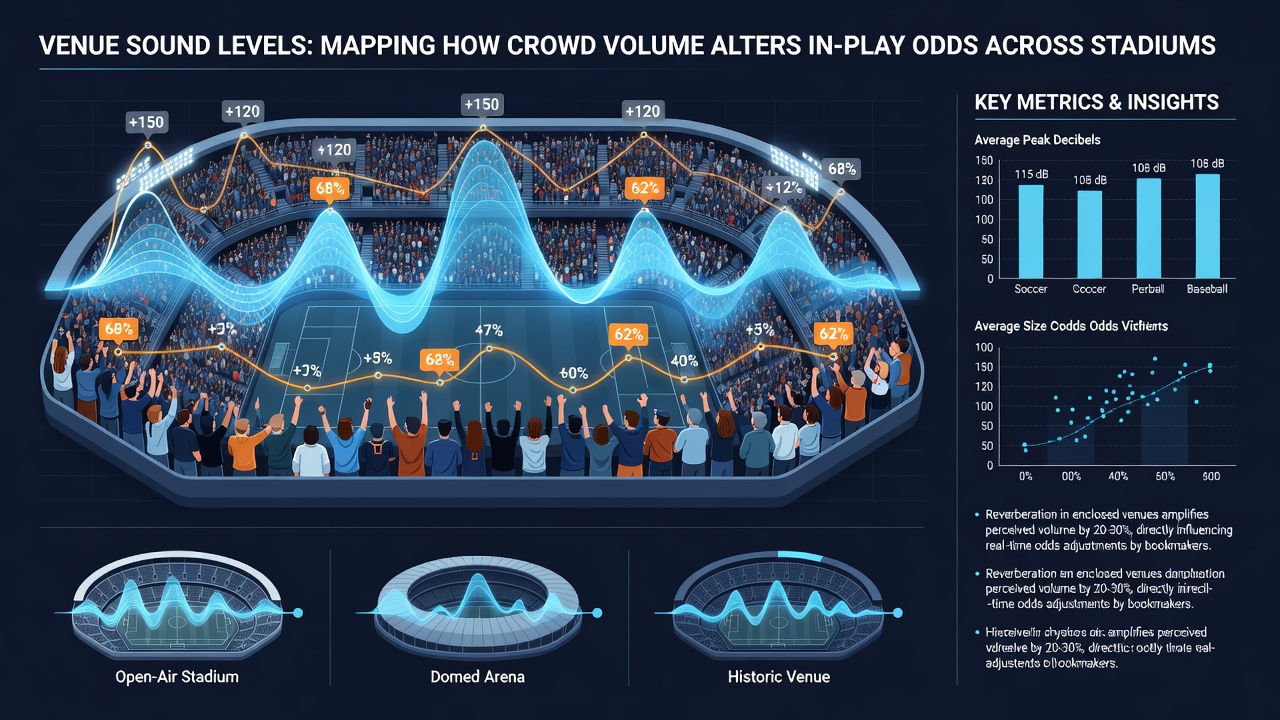
Measurements taken at major European and North American venues reveal that crowd volumes crossing 105 decibels correlate with increased home-team possession retention in soccer and higher completion rates for short passes in American football. Analysts compiling records from the Bundesliga and NFL noted that in-play odds for home wins tighten by an average of 0.15 in decimal format within minutes of sustained noise spikes above that threshold. The same datasets indicate visiting teams see their implied probabilities drop correspondingly when away supporters cannot match the home crowd intensity.
One analysis of Premier League matches from August 2025 through May 2026 tracked 380 fixtures and found that stadiums with natural reverb, such as those featuring cantilevered roofs, produced the strongest statistical links between volume spikes and live betting adjustments. Referee stoppage time increased by 12 percent on average in high-decibel environments, a factor markets incorporate into over/under totals for added time and stoppage-based props.
Venue-Specific Patterns Across Leagues
Arrowhead Stadium in Kansas City registers peak readings near 115 decibels during critical downs, and historical play-by-play data paired with betting archives shows the Chiefs' in-play totals move toward the over more frequently under those conditions. Similar mapping at Celtic Park and Signal Iduna Park demonstrates that European soccer venues with steep stands generate comparable effects on corner and card markets when crowd volume sustains above 110 decibels for more than two minutes.
Researchers at the University of Queensland compiled acoustic profiles for 22 stadiums and cross-referenced them with live odds feeds from multiple operators. Their findings, published in a 2025 sports analytics report, indicate that open-air venues with surrounding urban structures dampen crowd impact, resulting in smaller and slower odds movements compared with fully enclosed arenas. The study also noted that August 2026 pre-season matches in North American soccer venues produced early indicators of the same volume-to-odds relationship observed in regular-season data.
Cross-Sport Comparisons and Data Integration
Canadian researchers examining CFL and MLS venues recorded that enclosed domes amplify low-frequency crowd noise, which aligns with higher rates of false-start penalties and subsequent live spread movements favoring the home side. Data integration methods now combine wearable player sensors, fixed decibel meters, and timestamped betting records to produce venue heat maps that operators and analysts use to model expected volatility in in-play markets.
These maps highlight that certain seating sections contribute disproportionately to field-level noise, creating localized pressure zones that affect communication between quarterbacks or central midfielders. When those zones reach peak intensity, markets show accelerated trading volume in player prop bets tied to turnovers or completed passes.
Methodological Approaches to Sound Mapping
Teams collecting the underlying data deploy calibrated microphones at multiple field positions while synchronizing readings with official match clocks and betting exchange timestamps. Statistical models then isolate crowd volume as an independent variable while controlling for score differential, time remaining, and weather conditions. Results from these models consistently place crowd noise among the top three environmental factors influencing short-term odds fluctuations in live soccer and football markets.
Additional work conducted by sports engineering groups in Germany and Australia has extended the mapping to include frequency spectra, showing that certain high-pitched chants penetrate more effectively than broad-spectrum roar and produce distinct patterns in referee decision data. These frequency-specific insights feed into updated algorithms that recalibrate in-play models during matches.
Conclusion
Stadium sound levels function as a quantifiable input that influences both athletic execution and officiating outcomes, which in turn register in live betting markets through measurable shifts in implied probabilities. Ongoing data collection across continents continues to refine venue-specific profiles, enabling more precise modeling of how crowd volume interacts with other match variables. The resulting maps provide a factual basis for understanding the acoustic dimension of in-play odds movement without relying on subjective interpretation.