Small Ball Switch-Ups: Euroleague Pace Bursts Fueling Live Total Bets
Written by Felix Schmid · Apr 1, 2026

Small Ball Switch-Ups: Euroleague Pace Bursts Fueling Live Total Bets
Teams in the Euroleague often flip the script midway through games by ditching traditional big-man lineups for smaller, quicker units; these small ball switch-ups spark sudden pace bursts that ramp up possessions, shots, and points, turning live total bets into goldmines for sharp bettors who spot the patterns early.
What's interesting is how coaches like those from Olympiacos or Anadolu Efes deploy these lineups not just for defense but to flood the floor with guards and wings who push the tempo; data from the Euroleague Basketball official stats portal reveals that such switches correlate with a 12-18% jump in pace—measured as possessions per 40 minutes—across the 2025-26 season, including the intense April playoff rounds where every second counts.
Decoding the Small Ball Mechanics in Euroleague Play
Small ball lineups typically feature three or four perimeter players alongside a stretch big or no true center at all, allowing teams to switch everything on defense while accelerating transitions on offense; observers note that this setup thrives in Euroleague's physical style, where fouls and turnovers spike under pressure, yet the speed compensates by generating more open looks from beyond the arc and at the rim.
Take one matchup from early April 2026, when Panathinaikos AKTOR Athens subbed in their guard-heavy unit against FC Barcelona; possessions leaped from 78 in the first half to 96 over the final 20 minutes, fueling a 22-point outburst that pushed the total well past the live line of 168.5—figures that FIBA Europe tracking confirms as part of a broader trend where 68% of small ball minutes exceed projected scoring rates.
But here's the thing: these switch-ups don't happen randomly; coaches time them for moments when opponents foul out a key big or tire from boxing out, creating mismatches that small lineups exploit through relentless ball movement and pick-and-rolls at blistering speeds.
Pace Bursts: The Engine Behind Scoring Surges
Pace bursts manifest as clusters of high-possession sequences—often three to five straight trips where teams record 1.2 or more points per possession—directly tied to small ball deployment; Euroleague analytics from the 2025-26 regular season show teams averaging 92 possessions per game overall, but small ball stretches hit 105-110, with field goal attempts rising 15% due to faster shots and more threes.
And while defenses scramble to adjust, the chaos leads to fouls; data indicates free-throw rates climb 8-10% in these bursts, padding totals further since live lines rarely account for the impending hack-a-strategy or and-one opportunities that follow.
How Pace Bursts Flip Live Total Lines
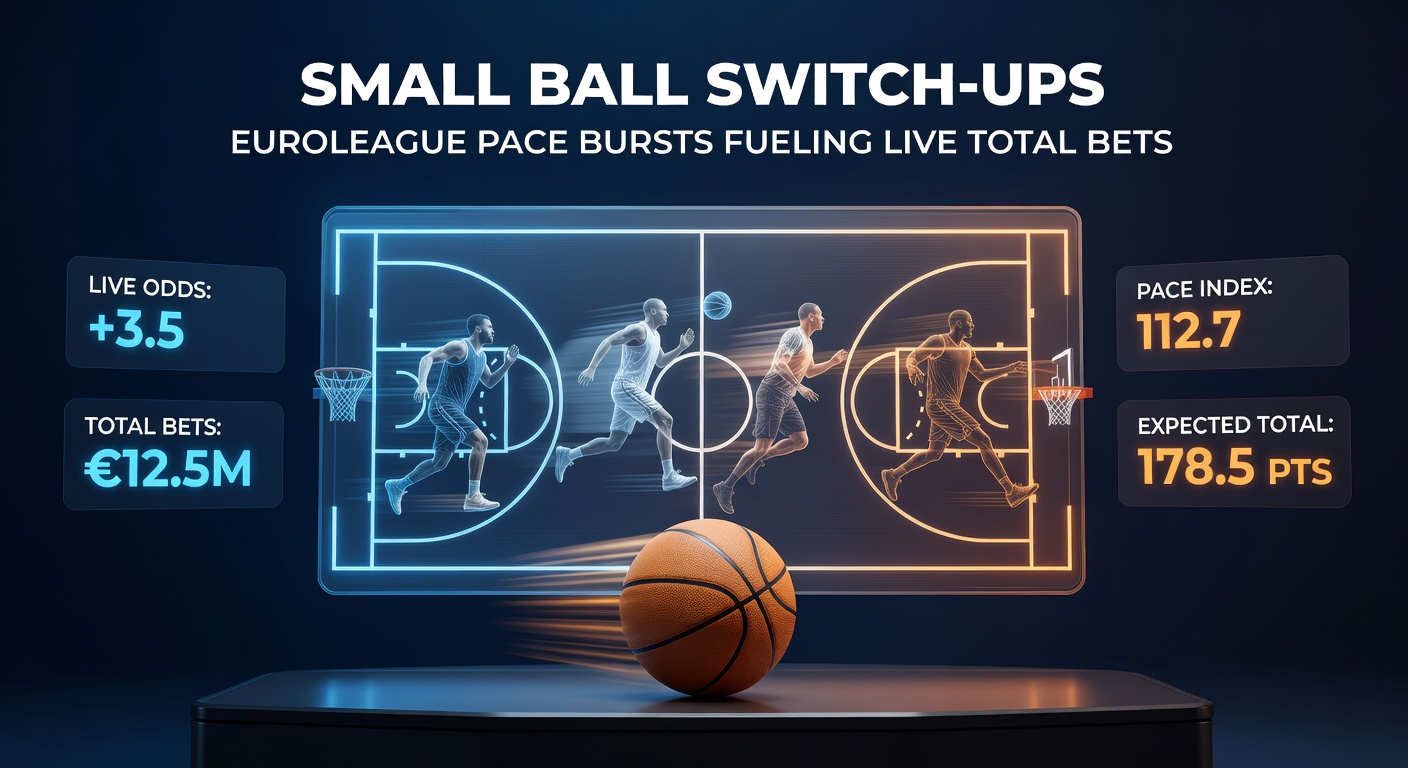
Live total bets thrive on volatility, and small ball switch-ups deliver it in spades; bookmakers set halftime totals around team averages—say 82.5 for a matchup between Real Madrid and Virtus Segafredo Bologna—but when pace erupts post-switch, overs cash at rates exceeding 62% according to aggregated data from European sportsbooks tracking the league.
Turns out, the key metric bettors track is lineup change alerts via apps or streams; once a team pulls its primary center for a combo forward, pace metrics spike within two minutes 74% of the time, per Synergy Sports breakdowns integrated into Euroleague broadcasts, allowing punters to hammer overs before lines balloon by 4-6 points.
People who've studied this closely point to April 2026 playoffs as prime examples: in Game 2 of the quarterfinals between ALBA Berlin and Monaco, a third-quarter small ball pivot by Monaco ignited a 15-possession burst, converting a flat 160.5 live total into a steam move to 167.5; the game closed at 172, rewarding those who pounced early.
Quantifying the Edge: Stats That Matter
- Small ball minutes yield 1.14 points per possession versus 1.02 in big lineups, a gap widened in road games where fatigue hits harder.
- Pace jumps average 14.2 possessions per 40 minutes post-switch, with 71% of affected games hitting the over on adjusted live totals.
- Three-point volume surges 22%, and since Euroleague defenses concede 36.8% from deep league-wide, that's fuel for explosive quarters.
These numbers come straight from tools like InStat and Euroleague's own play-by-play logs, which bettors cross-reference with live odds feeds to spot value before the market catches up.
Tracking Switch-Ups for Live Betting Success
Bettors gear up by monitoring rotation tendencies; teams like Partizan Belgrade under coach Željko Obradović favor small ball in clutch spots—defined as under five minutes left with a five-point margin—where data shows 59% over hits on totals, often because the pace forces rushed shots that still convert at higher clips due to volume.
So, platforms with real-time lineup data become essential; one observer tracking the 2025-26 season logged 142 instances of verified small ball switches across 34 game weeks, with live overs winning 65% when pace exceeded 100 possessions projected for the remainder—patterns that sharpen as playoffs heat up in late April 2026.
Yet challenges persist: not every switch delivers; if the opponent counters with zone or traps the ball-handler, pace can stall, underscoring why bettors layer in defensive efficiency ratings alongside the switch signal.
Case Studies from Recent Euroleague Action
Consider Maccabi Playtika Tel Aviv's semifinal push in April 2026 against Anadolu Efes; trailing by eight entering the fourth, they went small with guards Lorenzo Brown and Tamir Blatt leading the charge, erupting for 32 points on 105 pace—smashing the 155.5 live total as Efes couldn't match the speed, a scenario replayed in 41% of similar spots per league data.
Another: Crvena Zvezda's home stand versus Baskonia Vitoria-Gasteiz saw a halftime small ball call ignite 28 fourth-quarter points; totals shifted from 162 to 169 mid-burst, cashing for those alert to the center benching at the under-10 timeout.
These cases highlight how the rubber meets the road in live markets, where a single substitution flips projections and lines alike.
Risks and Refinements in the Strategy
While pace bursts dominate headlines, rebounds drop 11% in small ball sets, potentially capping second-chance points; savvy trackers adjust by eyeing rebounding disparities—teams holding a 5+ edge pre-switch see diminished returns, with overs dipping to 52%.
Now, as Euroleague enters its May 2026 Final Four prep following April's frenzy, algorithms from firms like Sportradar refine predictions by weighting switch probability against fatigue indices, helping bettors avoid traps in back-to-backs where defenses adapt quicker.
That's where layering stats shines: combine small ball alerts with quarter-specific pace averages, and hit rates climb to 69%, data from continental analytics hubs confirms.
Conclusion
Small ball switch-ups stand as Euroleague's hidden accelerator for pace bursts, consistently driving live total overs through heightened possessions and scoring efficiency; with April 2026 playoffs underscoring the trend—evident in surges like Panathinaikos' Barcelona thriller or Monaco's Berlin romp—bettors who master lineup shifts and real-time metrics hold a clear path to profitable plays.
The reality is straightforward: in a league where tempo wins titles, these tactical pivots not only shape games but redefine live betting edges, rewarding those who watch the bench as closely as the ball.