Court Surface Variations Reshape Serve Dominance Patterns Across Global Tennis Circuits
Written by Petra Frank · Jul 27, 2026
Court Surface Variations Reshape Serve Dominance Patterns Across Global Tennis Circuits
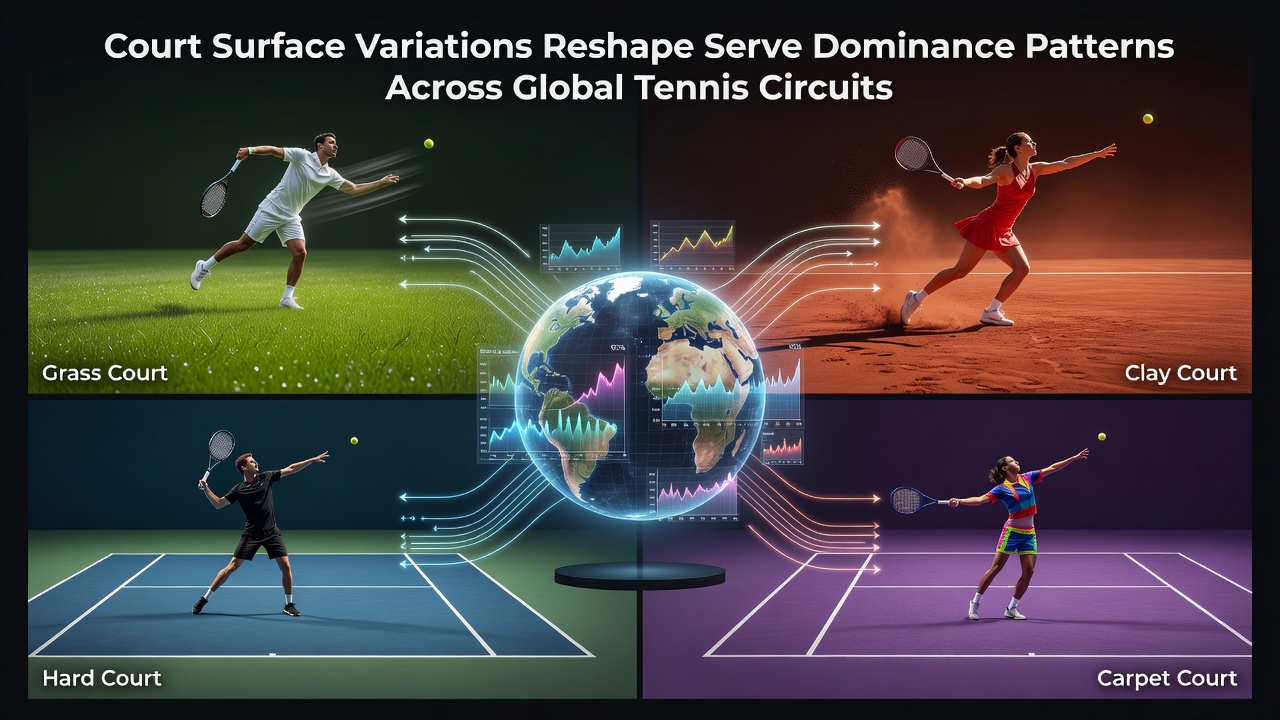
Data from major tournaments indicate that court surface variations continue to influence serve dominance patterns across ATP and WTA circuits, with measurable differences in ace percentages and service game hold rates emerging season after season. Researchers tracking performance metrics note that grass courts accelerate ball speeds while reducing bounce heights, conditions that favor players who rely on flat, high-velocity deliveries. In contrast, clay surfaces slow the ball and increase bounce, patterns that reduce the effectiveness of pure power serves and shift outcomes toward extended rallies.
Grass Court Dynamics and Serve Efficiency
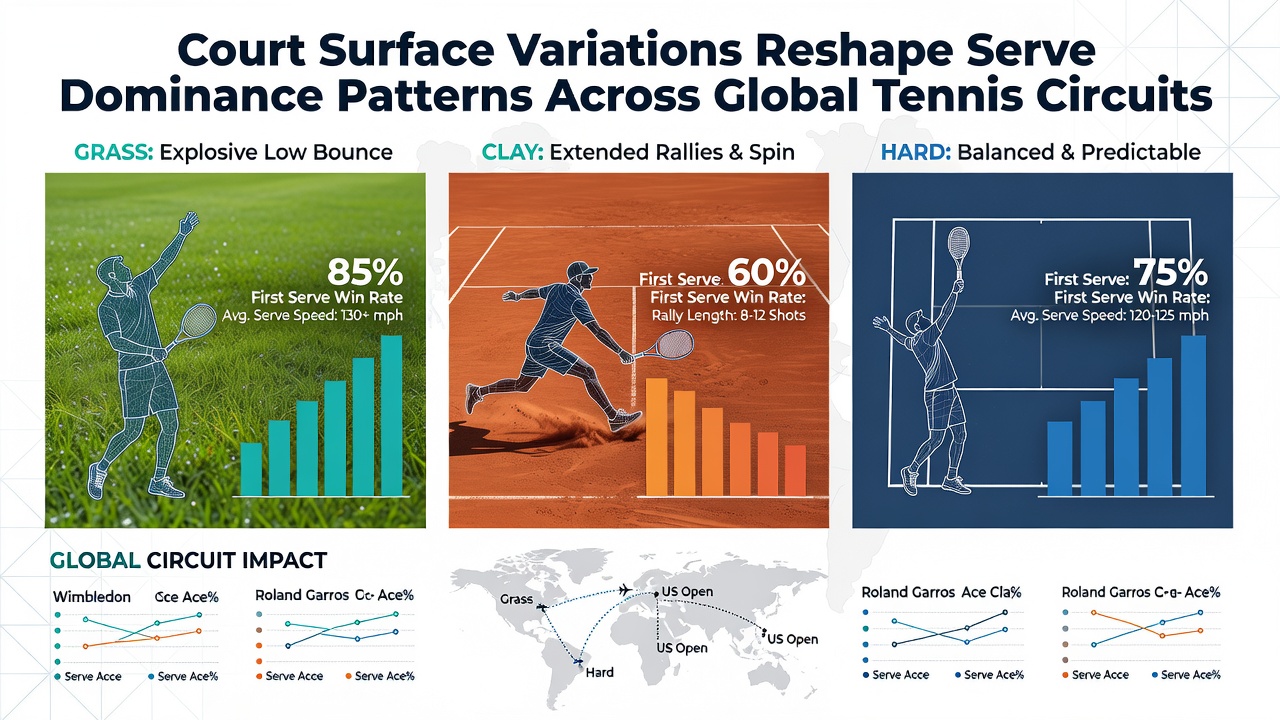
Grass courts at venues such as Wimbledon produce the highest average serve speeds recorded on the professional calendar, figures that reach 130 miles per hour for top servers during peak matches. Service game hold rates on grass often exceed 85 percent for players ranked in the top 20, according to aggregated tournament statistics released by the ATP. These conditions reward players who employ serve-and-volley tactics because the low bounce limits returners' ability to redirect aggressive returns. Observers tracking Wimbledon results through July 2026 highlight that ace counts per match rise notably compared with other surfaces, a trend consistent with historical data sets maintained by the International Tennis Federation.
Clay Court Effects on Serve Outcomes
Clay courts at events including the French Open generate slower ball velocities and higher bounce trajectories, factors that lower ace percentages to averages below 6 percent in many matches. Hold rates on clay typically fall into the 70 to 75 percent range for elite players, data that reflects increased break opportunities created by extended rally lengths. Studies conducted by sports science teams at European training centers show that players attempting high-speed serves on clay experience greater dispersion in landing zones because the surface friction alters spin and trajectory after impact. This pattern forces adjustments in serve placement, with many competitors shifting toward kick serves that exploit the higher bounce rather than flat power serves.
Hard Court Variations Across Regional Circuits
Hard courts used in the Australian Open and US Open produce intermediate bounce and speed characteristics that fall between grass and clay. Average ace rates on these surfaces hover around 8 to 10 percent, while service game hold percentages range from 78 to 82 percent depending on tournament and player profile. North American hard court events often feature slightly faster playing conditions than their Asian counterparts, a distinction documented in speed gun readings collected by tournament officials. Data compiled from the 2025 and 2026 seasons reveal that players with wide serve arsenals maintain higher hold rates on these courts because the consistent bounce allows precise placement without excessive surface interference.
Global Circuit Comparisons and Statistical Trends
Analysis of serve statistics across the four Grand Slam tournaments demonstrates clear surface-driven divergences that repeat annually. Wimbledon grass produces the largest gap between first-serve win percentages and second-serve win percentages, a margin that often exceeds 20 percentage points. Roland Garros clay narrows this gap substantially because returners gain more time to react. Hard court majors show intermediate spreads that vary with weather conditions and court preparation methods employed by each venue. Researchers affiliated with the Australian Institute of Sport have published longitudinal studies tracking these metrics, and their findings align with data released by the ATP and WTA statistical departments.
Regional tours further illustrate how surface preparation influences serve dominance. European clay swing events consistently record the lowest ace frequencies, whereas North American and Australian hard court swing tournaments produce moderate increases. Grass court exhibitions and challenger events, though fewer in number, mirror the serve-heavy patterns observed at Wimbledon. Tournament directors adjust ball types and court maintenance schedules to maintain consistency within each surface category, yet natural variations in humidity, temperature, and wear still produce measurable differences in ball behavior.
Player Adaptation and Tactical Adjustments
Players who transition between surfaces demonstrate measurable changes in serve selection and positioning. Those who favor flat serves often increase slice and kick serve usage on clay to compensate for reduced pace, a tactical shift documented in match footage reviewed by coaching staffs. On grass, competitors who normally construct points from the baseline adopt more aggressive net approaches after strong serves because the surface rewards quick points. Hard courts allow greater flexibility, enabling players to mix serve types without major strategic overhauls. Performance analysts tracking movement data note that footwork patterns also adjust according to surface, with shorter recovery steps required on faster courts to maintain optimal serving stance.
Conclusion
Court surface characteristics continue to shape serve dominance patterns across professional tennis, with grass, clay, and hard courts each producing distinct statistical signatures. Data collected through 2026 confirm that these variations remain consistent across Grand Slams and regional circuits, influencing player preparation, tactical choices, and match outcomes in predictable ways. Organizations such as the ITF and regional federations maintain ongoing monitoring programs that track these metrics, providing the foundation for future surface management decisions.